
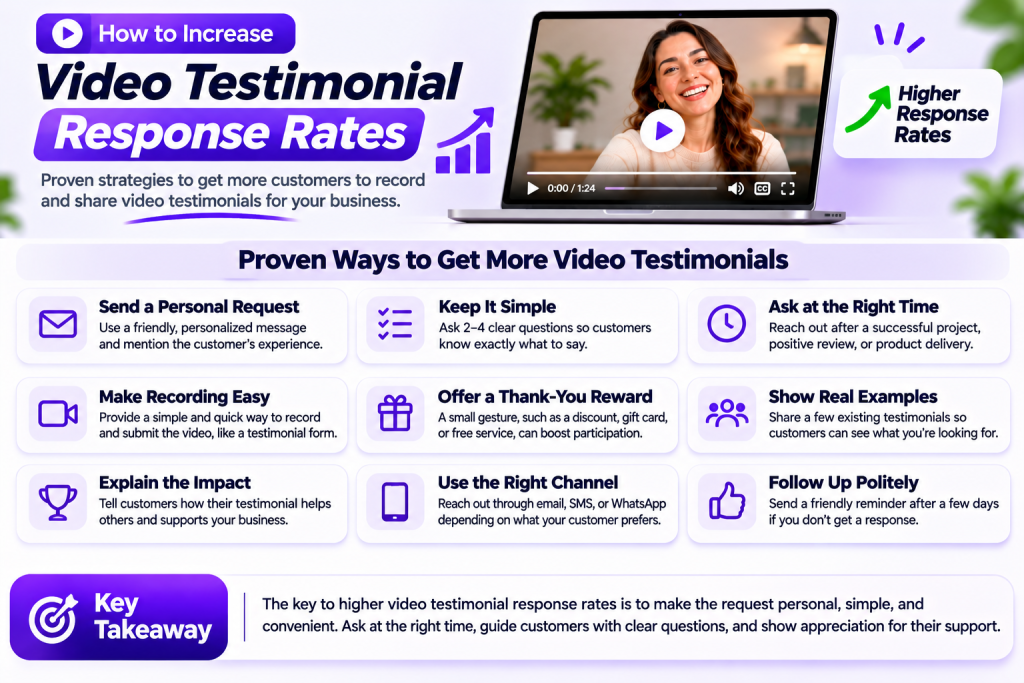
Video testimonials are one of the most powerful ways to build trust with potential customers. They allow people to hear directly from real customers, understand their experiences, and see the value your business provides.
However, getting customers to actually record and submit a video testimonial can be challenging. Even satisfied customers may ignore your request, forget to respond, or feel uncomfortable speaking on camera.
The solution isn’t simply asking more people. It’s making the entire process easier, more personal, and more appealing.
In this guide, we’ll explore practical strategies to increase video testimonial response rates and encourage more customers to share their experiences.
1. Ask Customers at the Right Time
Timing has a major impact on whether someone responds to your testimonial request.
If you ask too early, customers may not have experienced enough value from your product or service. If you wait too long, they may forget the details of their experience.
The best time to request a video testimonial is when customers are genuinely happy with the results.
Consider reaching out after:
- A successful project or service completion.
- A customer achieves an important goal.
- Positive feedback or a five-star review.
- A successful product delivery.
- A customer expresses appreciation for your work.
For example, if a client tells you they’re happy with the results of a project, that’s an excellent opportunity to ask whether they’d be comfortable sharing their experience in a short video.
2. Make Your Request Personal
Generic messages often feel automated and are easy to ignore.
Instead of sending the same message to everyone, personalize your request by mentioning the customer’s name, their experience, or something specific about their journey.
For example, rather than saying:
“Please leave us a video testimonial.”
Try something more personal:
“Hi! We’re really glad you enjoyed working with us. Your feedback means a lot, and we’d love to hear a little about your experience in a short video.”
A personal message makes customers feel appreciated rather than treated like another name on a marketing list.
You don’t need a complicated message. A friendly, genuine request can make a significant difference.
3. Keep the Recording Process Simple
One of the biggest reasons customers don’t submit video testimonials is that recording one feels like too much work.
They might wonder:
- What should I say?
- How long should the video be?
- Where should I record it?
- How do I send it?
- Does the video need professional editing?
Remove as much uncertainty as possible.
Give customers a simple way to record and submit their feedback. Explain that a smartphone camera is perfectly fine and that they don’t need professional equipment.
A short video of 30 to 90 seconds is often enough to communicate a meaningful customer experience.
The easier you make the process, the more likely customers are to complete it.
4. Give Customers Clear Questions to Answer
Many customers want to help but don’t know what to say when they start recording.
Instead of asking them to talk about their entire experience, provide three or four simple questions.
For example:
- What challenge were you facing before working with us?
- Why did you choose our product or service?
- What was your experience like?
- What would you tell someone considering our business?
These questions provide direction without making the testimonial sound scripted.
Let customers answer naturally in their own words. Authentic experiences are more convincing than rehearsed marketing statements.
5. Explain Why Their Feedback Matters
Customers are more likely to participate when they understand the purpose of their contribution.
Explain that their testimonial could help other people make informed decisions, understand your services, and feel more confident about working with your business.
For example:
“Your experience could help someone who is considering the same service make a more confident decision. We’d really appreciate it if you could share your story.”
This approach gives customers a reason to participate beyond simply helping your business with marketing.
Keep the explanation genuine. Avoid exaggerating the impact of their contribution.
6. Show Examples of Good Video Testimonials
Some customers hesitate because they don’t know what a finished testimonial should look like.
Sharing a few examples can help them understand what you’re asking for.
Show examples that demonstrate:
- A natural speaking style.
- A short and straightforward recording.
- Clear answers about the customer experience.
- A simple recording environment.
- Honest feedback rather than scripted advertising.
Make it clear that customers don’t need to copy the examples. Their own words and experiences are what make their testimonials valuable.
7. Use the Communication Channel Customers Prefer
Not every customer responds to email. Some people are more comfortable communicating through text messages, while others prefer WhatsApp or another familiar channel.
Consider where your customers are already communicating with your business.
Common channels include:
Email: Useful for professional requests, detailed instructions, and direct recording links.
SMS: Effective for short, straightforward requests and reminders.
WhatsApp: Convenient for businesses that already communicate with customers through WhatsApp.
In-person requests: Particularly useful when a customer has just shared positive feedback during a meeting or appointment.
Choose the channel that feels natural for your audience. Avoid sending repeated requests across multiple channels, as this can feel intrusive.
8. Send Friendly Follow-Up Reminders
Sometimes customers intend to record a testimonial but simply forget.
A polite follow-up can bring your request back to their attention.
If someone hasn’t responded after a few days, send a short reminder.
For example:
“Hi! Just wanted to follow up on our previous message. We’d still love to hear about your experience if you have a moment. No pressure at all, and we really appreciate your support!”
A good follow-up should be:
- Friendly and respectful.
- Short and easy to understand.
- Clear about the original request.
- Free from pressure or guilt.
One or two thoughtful reminders are generally better than repeatedly messaging customers.
If someone declines or doesn’t want to participate, respect their decision.
9. Offer a Small Thank-You Incentive
A small incentive can encourage more customers to participate, especially when recording a testimonial requires additional time.
Depending on your business, you could consider:
- A discount on a future purchase.
- A small gift card.
- A loyalty reward.
- A complimentary service.
- Entry into a clearly explained giveaway.
However, incentives should never be conditional on giving positive feedback. Customers should remain free to share honest opinions, including constructive criticism.
Always communicate the terms clearly and follow applicable review, advertising, and disclosure guidelines.
10. Use a Dedicated Testimonial Collection Form
Sending customers a long list of instructions or asking them to reply with a large video attachment can create unnecessary friction.
A dedicated testimonial collection form provides a more organized way to gather customer feedback.
With a platform like Getform.ai, businesses can create forms that collect video, audio, and written feedback using the available form fields.
A simple collection form can help you:
- Introduce the testimonial request.
- Provide clear recording instructions.
- Ask relevant questions.
- Collect customer details.
- Receive video and written responses in one organized process.
The goal is to give customers a straightforward way to share their experiences without making them navigate a complicated submission process.
Remember that collecting a video and publishing or displaying it are separate steps. Make sure customers understand how their submissions may be used and obtain the necessary permission before publishing them.
11. Make the Request Mobile-Friendly
Many customers will open your testimonial request on their smartphones.
If the process is difficult to complete on a mobile device, they may abandon it.
Make sure your collection experience:
- Works smoothly on smartphones.
- Uses readable text and clear instructions.
- Avoids unnecessary questions.
- Provides straightforward submission steps.
- Doesn’t require customers to navigate multiple pages unnecessarily.
Before sending a testimonial request to customers, test the entire process on a mobile device.
A smooth mobile experience removes another potential reason for customers not to respond.
12. Track Your Testimonial Response Rates
If you want to improve results consistently, you need to understand how customers respond to your requests.
Start by tracking a few basic metrics:
| Metric | What It Measures |
|---|---|
| Requests sent | Number of customers contacted |
| Responses received | Customers who replied |
| Videos submitted | Completed video testimonials |
| Response rate | Percentage of customers who responded |
| Completion rate | Percentage of customers who submitted a video |
For example, if you send 100 testimonial requests and receive 20 completed video submissions, your video submission rate is 20%.
Use this information to identify what works.
You can experiment with different message styles, request timing, communication channels, and question formats. Change one major element at a time so you can understand which adjustments make a difference.
Example: A Simple Video Testimonial Request Message
Here’s a friendly message you can adapt for customers:
“Hi! We really appreciate you choosing us and would love to hear about your experience.
Would you be comfortable sharing a short video testimonial about your journey with us?
It doesn’t need to be professionally recorded. A simple video using your phone is absolutely fine.
Your honest feedback could help others understand what it’s like to work with us.
Thank you for your support!”
Keep your message conversational and make sure the recording process is easy to access.
Frequently Asked Questions
1. What is a good video testimonial response rate?
There is no universal response rate that applies to every business. Results depend on your audience, customer relationships, request timing, industry, and recording process. Track your own results over time to establish a realistic benchmark.
2. When should I ask customers for video testimonials?
Ask when customers have recently experienced a positive outcome, completed a project, received a product, or expressed satisfaction with your service.
3. How long should a video testimonial be?
A video between 30 and 90 seconds is often sufficient. Encourage customers to focus on their experience rather than trying to create a lengthy presentation.
4. How many times should I follow up?
One or two polite reminders are usually a reasonable starting point. Avoid excessive follow-ups and respect customers who decline.
5. Should I offer incentives for video testimonials?
You can offer a small thank-you incentive, provided it isn’t conditional on positive feedback. Be transparent about the incentive and follow relevant disclosure requirements.
6. How can I collect video testimonials automatically?
You can use a testimonial collection form to organize requests and submissions. Getform.ai supports creating forms that collect video, audio, and text feedback through available form fields, helping businesses simplify the collection process.
Conclusion
Increasing video testimonial response rates starts with understanding your customers and removing the obstacles that prevent them from participating.
Ask at the right moment, personalize your messages, provide simple questions, make recording convenient, and follow up respectfully.
Most importantly, make customers feel that their experiences genuinely matter.
You don’t need complicated campaigns or aggressive reminders to collect more testimonials. A clear request and a smooth submission experience can make it easier for satisfied customers to share their stories.
With a consistent approach and a simple collection process, your business can build a growing library of authentic customer feedback that helps establish trust and support future growth.